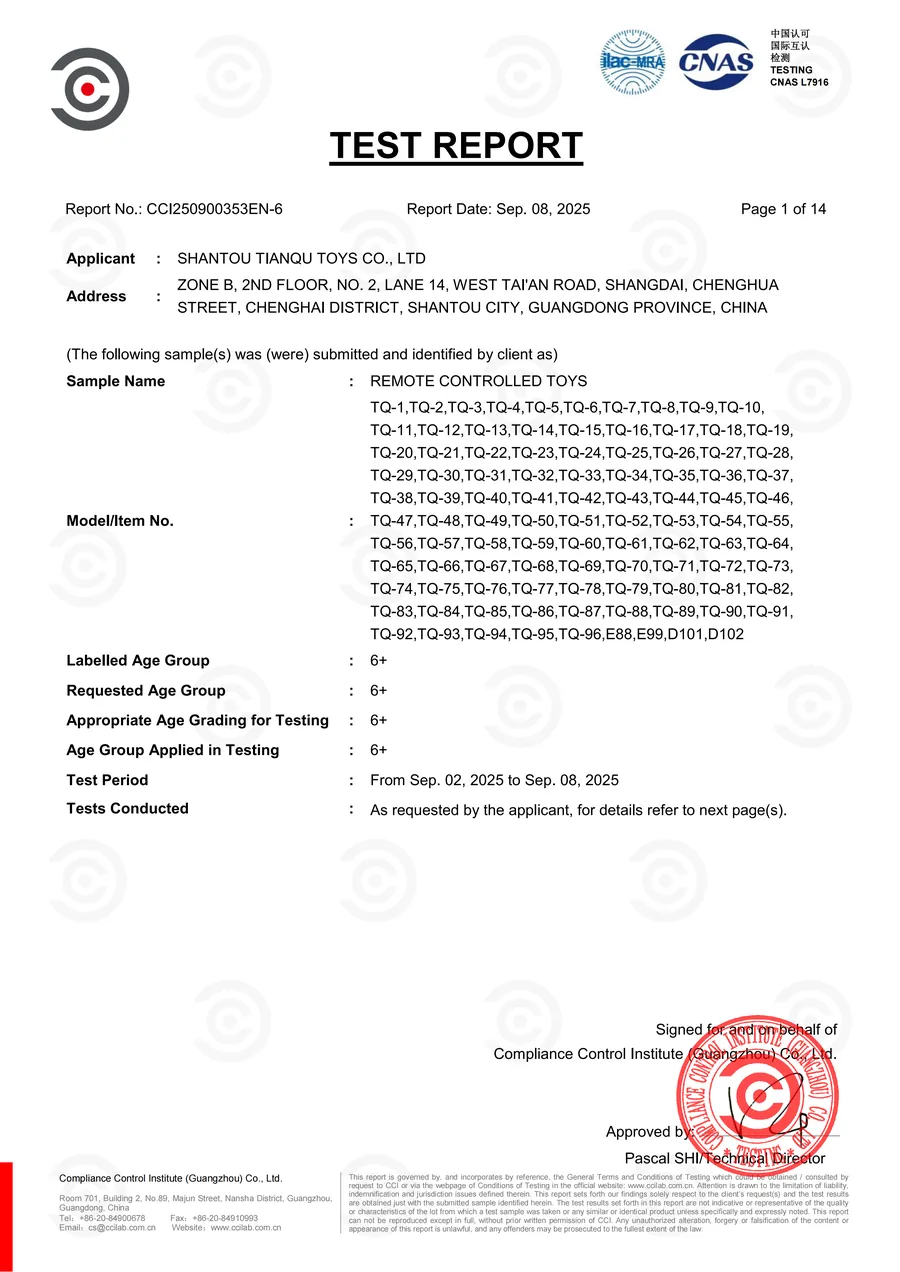
If you import toys into the United States, the paperwork routine you knew has changed. Since July 8, 2026, a Children's Product Certificate (CPC) saved in a shared folder and shown on request is no longer sufficient — the certificate's data must be filed electronically with US Customs and Border Protection (CBP), in the ACE system, at the time of entry. Missing or mismatched data can hold a shipment at the port.
This article explains what the eFiling rule requires, who is responsible, and — from the manufacturer's side — exactly what your supplier should hand you so your customs broker can file without delays.
What Changed, and When
The rule is the revision of 16 CFR Part 1110 published by the Consumer Product Safety Commission (CPSC) on January 8, 2025. In short, certificate data moved from "on file, shown if asked" to "filed electronically before the goods arrive":
| Date | What applies |
|---|---|
| July 8, 2026 | eFiling mandatory for most imported consumer products regulated by CPSC — including toys and other children's products |
| January 8, 2027 | Deadline for goods withdrawn from Foreign Trade Zones (FTZ) |
Two practical points importers should know. First, there is no small-lot exemption: the obligation follows the product category, not the shipment value, so trial orders and samples that fall under a CPSC rule are covered too. Second, the border posture is softer than the headlines suggest — and it matters that you understand exactly how far that goes. In the Cargo Systems Messaging Service notice CBP issued on the compliance date itself (CSMS #69177694, 8 July 2026), the agency confirmed that an entry will not be blocked or refused simply because CPSC certificate data is missing: at this stage, follow-up moves to manual review, random targeting and post-entry audit rather than an automatic stop at the port. That leniency applies to the filing mechanics only — it is not a compliance amnesty. A toy without a valid CPC, or one that fails the underlying safety standard, is still exposed to detention, seizure, recall and civil penalties; and importers who repeatedly file incomplete data feed CBP's targeting rules, which means more examinations on later shipments. File correctly from the first entry and the question never comes up.
Who Must File
The legal obligation sits with the importer of record — the US buyer, not the Chinese factory. Your customs broker does the actual filing in ACE using the CPSC Partner Government Agency (PGA) Message Set, but the data behind it must come from the manufacturer and the testing laboratory.
This is why the rule matters on both sides of the ocean. If a factory's certificate is vague, outdated, or describes a product differently from the commercial invoice, the entry data will not match, and the shipment can be held. Importers should treat supplier documentation quality as a supplier-selection criterion, not an afterthought.
CPC or GCC: Which Certificate Applies
| Children's products (CPC) | General-use products (GCC) | |
|---|---|---|
| Applies to | Toys and any product designed or intended primarily for children 12 or under | Consumer products subject to a CPSC rule but not intended for children |
| Testing basis | Third-party testing by a CPSC-accepted laboratory — mandatory | Reasonable testing program or third-party lab, depending on the rule |
| Common examples | Robot dogs, RC toys, plush, dolls | Furniture, lighters, certain household goods |
A remote control robot dog is a children's product, so it needs a CPC based on third-party testing — for toys, that means ASTM F963 (toy safety), plus the lead and phthalates limits under CPSIA, and for anything with a battery, the lithium battery transport tests covered in our certifications overview.
The Seven Data Elements Your Broker Will Ask For
At entry, the filing must carry seven core data elements for each regulated product:
- Product identifier — the model or SKU that ties the certificate to the goods on the invoice
- Citation of rules — each CPSC rule the product was tested against (for toys: ASTM F963, CPSIA lead, phthalates, and so on)
- Manufacture date — month and year of production
- Place of manufacture — the factory's full name and address
- Test date — when the product was last tested for compliance
- Testing laboratory — the lab's name and address
- Point of contact — who holds the records supporting the certificate, with contact details
One detail trips up first-time filers: under the revised rule, each finished product certificate describes only one product. A single broad certificate covering "assorted toys" no longer works — if you order three models, each model needs its own certificate data.
Two Ways to File
CPSC supports two filing modes in ACE:
- Full PGA Message Set — the broker submits all seven elements with each entry. Workable if you import a small number of SKUs.
- Reference (abbreviated) PGA Message Set — certificate data is registered once in CPSC's Product Registry; subsequent entries carry only the product ID, certifier ID and certificate version ID. This suits importers re-ordering the same models repeatedly, which describes most toy programs.
Ask your broker early which mode they can support, because it changes what you need from your supplier and when — and if the answer is the Product Registry, start now: CPSC and the major carriers both warn that completing registration can take up to six months.
What Happens If the Data Is Missing
An entry without the required CPSC data — or with data that does not match the goods — risks being rejected or held for examination, and CPSC can pursue civil penalties for violations. Beyond the immediate delay, repeated discrepancies put an importer on the wrong side of targeting algorithms, which means more exams on every future shipment. None of that is worth risking over a certificate file your supplier should already maintain.
What We Provide as the Manufacturer
We are the factory, so we cannot file for you — the obligation is yours as importer of record — but we make sure the data your broker needs is complete and consistent:
- Current CPC for each model, supported by third-party laboratory testing against ASTM F963 and CPSIA requirements, with the certificate identifier (our CPC registration ID is 1566) and testing laboratory details
- Accurate manufacturer identity — the legal entity and plant address in Chenghai, Shantou, matching what appears on your commercial invoice
- Production dates and batch information for the shipment, so the manufacture-date element in your filing matches the goods
- Battery transport documentation — UN 38.3 test summaries and DGM air/sea reports for the lithium packs inside our robot dogs, which your forwarder needs alongside customs data
If you are setting up eFiling for a first order, send us your broker's data checklist and we will return the certificate package against it line by line. That is normally a same-week turnaround.
A Quick Pre-Shipment Checklist
- [ ] CPC for each model, based on third-party testing, currently valid
- [ ] Certificate describes exactly the model/SKU on the invoice
- [ ] Manufacturer name and address match the invoice and the certificate
- [ ] Tracking labels on product and packaging carry the manufacturer mark and production date
- [ ] Test reports dated and from a CPSC-accepted laboratory
- [ ] Broker has confirmed the filing mode (full message set vs Product Registry)
- [ ] Battery documentation (UN 38.3, DGM) with the forwarder
Sources
- CPSC, eFiling Guidance for Foreign Trade Zones (July 2025) — official guidance summarising the Part 1110 final rule, effective dates, and ACE/PGA Message Set filing — cpsc.gov (PDF)
- 16 CFR Part 1110 (Certificates of Compliance), current text — eCFR
- CBP Cargo Systems Messaging Service — CSMS #68290359 (8 April 2026, mandatory eFiling announced) and CSMS #69177694 (8 July 2026, initial enforcement posture) — cbp.gov CSMS
- CPSC, Toy Safety Business Education — cpsc.gov
This article is general information for importers, not legal advice. Confirm the treatment of specific shipments with your customs broker or trade counsel.
Sources & further reading
- CPSC, eFiling Guidance for Foreign Trade Zones (July 2025) — official guidance summarising the Part 1110 final rule, effective dates, and ACE/PGA Message Set filing — cpsc.gov (PDF)
- 16 CFR Part 1110 (Certificates of Compliance), current text — eCFR
- CPSC, Toy Safety Business Education — cpsc.gov
This article is general information for importers, not legal advice. Confirm the treatment of specific shipments with your customs broker or trade counsel.